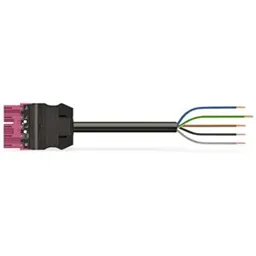
Cable assembly WINSTA ® MIDI with protection type IP20 Use effective pluggable connections instead of laborious screw connections: With the WINSTA ® MIDI cable assembly 5-pole. WAGO pluggable installation connectors are useful when specifications repeat or are distributed on a defined pattern, for example for installing grid lighting or flush-mount lighting. The mechanical coding and color coding of the pluggable installation connector ensure error-free installation of the individual components – including protection against mismating. The pluggable installation connector is protected against ingress by solid objects in accordance with protection type IP20 (When mated: IP2xC (These compact connectors are not designed for use in open, easily accessible areas!)). Electrical drive types, such as those used in sun protection systems or shading systems, can be activated via the SMI protocol. B coding enables the WINSTA ® MIDI pluggable installation connectors to be used for control in applications in automation, robotics, and mechanical engineering. WINSTA ® MIDI with Push-in CAGE CLAMP® spring pressure connection technology is used in can be found in a variety of projects you can use for quick, easy, flexible, and secure installation. This product meets all the relevant fire protection requirements of fire class E; therefore it can be used in domains where fire safety is relevant. Fast, secure pluggable connections – cable assemblies from WAGO The cable is pre-assembled with a plug and a free end. The WINSTA® Pluggable Connection System allows pluggable electrical installation. This significantly reduces the need for servicing and lowers costs. Now you can also reduce installation costs without compromising safety and quality: with protection type IP20 reduces the need for servicing and prevents unnecessary downtime. pluggable installation connectors with protection against mismating simple circuits with B coding for controllers, for example sun blinds and lighting fixtures ready to install and use immediately quick replacement of defective units during ongoing operation