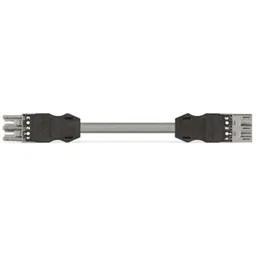
Cable assembly WINSTA ® MIDI B coding For power and signal transmission: The WINSTA ® MIDI cable assembly with protection type IP20. Our pluggable installation connectors with spring pressure connection technology work entirely without screw connections. They allow resource-efficient, error-free installation in numerous possible uses. For greater security in electrical installations, the pluggable installation connector is provided with mechanical protection against mismating. The pluggable installation connector is protected against ingress by solid objects in accordance with protection type IP20 (When mated: IP2xC (These compact connectors are not designed for use in open, easily accessible areas!)). Solutions like the WINSTA ® MIDI pluggable installation connectors with B coding are suitable for applications related to process control, for example, for lighting or in data networks. WINSTA ® MIDI with Push-in CAGE CLAMP® spring pressure connection technology is found in a broad range of individual products you can use for quick, easy, secure, tailored electrical installation. According to the European CPR, the fire class of the cables used for construction is essential for the safety of buildings, too. For buildings with average safety requirements, cable assemblies with fire class E are suitable. Pluggable connections instead of screw connections – cable assemblies from WAGO The cable is pre-assembled with a socket and a plug. WINSTA® is the pluggable connection system that is optimally tailored to the strict requirements of electrical installation. It ensures fast, secure and, above all, error-free installation of components and cables. Choose quality and durability – with protection type IP20 from WAGO makes the electrical installation of electrical components noticeably easier. pluggable installation connectors with protection against mismating for automation controllers with B coding for use in process automation, such as lighting technology, among other examples custom-engineered solutions fast, secure installation