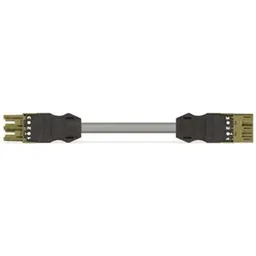
Cable assembly WINSTA ® MIDI with strain relief The WINSTA ® MIDI cable assembly 3-pole supports fast, reliable installation. WAGO pluggable installation connectors can be used when specifications repeat or are planned on a specified grid, for example for installing grid lighting or flush-mount lighting. The coding options reduce installation errors, allowing fast, maintenance-free wiring of all components. The pluggable installation connector is protected in accordance with protection type IP20 (When mated: IP2xC (These compact connectors are not designed for use in open, easily accessible areas!)). That results in the fact that users' fingers will never come into contact with energised elements. B coding enables the WINSTA ® MIDI pluggable installation connectors to be used for control in applications in the domains of automation, mechanical engineering and robotics. Our WINSTA ® MIDI product line offers maximum flexibility for the installation of applications. Through its Push-in CAGE CLAMP® spring pressure connection technology, it achieves error-free, time-saving installation and offers flexibility for meeting various installation requirements. Of course, the safety of buildings must always be ensured, even after the electrical installation has been performed. The required safety requirements in connection with EU CPR are met by this product through fire class E. Pluggable connections instead of screw connections – cable assemblies from WAGO The cable is pre-assembled with a socket and a plug. The WINSTA® Pluggable Connection System allows pluggable electrical installation. This saves time, lowers costs, and reduces the need for servicing. Enjoy the benefits of the pluggable version of our maintenance-free spring pressure connection technology too! Plan your installation with with protection type IP20 from WAGO. effective protection against mismating for automation controllers with B coding for use in automation of processes, such as lighting technology, for example ready to install and use immediately quick replacement of defective units during ongoing operation