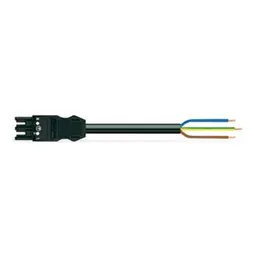
Cable assembly WINSTA ® MIDI A coding The WINSTA ® MIDI cable assembly with protection type IP20 provides the foundation for assembly of solid and fine-stranded conductors. Whether on PCBs, in control cabinets or for connecting lights – pluggable installation connectors from WAGO allow you to make connections according to many different requirements in seconds. The coding options reduce installation errors, allowing fast, secure wiring of all components. The pluggable installation connector is protected in accordance with protection type IP20 (When mated: IP2xC (These compact connectors are not designed for use in open, easily accessible areas!)). That results in the fact that users' fingers will never come into contact with energised elements. The WINSTA ® MIDI pluggable installation connector with A coding in black or white is normally used for general mains applications in power distribution. WINSTA ® MIDI with Push-in CAGE CLAMP® spring pressure connection technology is used in a broad range of individual products you can use for quick, easy and maximally flexible electrical installation. This product meets all the mandatory fire protection requirements of fire class E; therefore it can be used in areas where fire safety is relevant. Pluggable connections instead of screw connections – cable assemblies from WAGO The cable assembly is provided with a socket and a free end. The WINSTA® Pluggable Connection System is perfectly tailored to the very strict requirements of building installation. It makes electrical installation pluggable, and consequently faster, even more reliable, and error-free. Using this pre-assembled system decreases assembly times and errors during installation at the construction site. Choose quality and durability – with protection type IP20 from WAGO makes the electrical installation of electrical components significantly easier. protection against mismating eliminates errors for automation controllers with A coding for a great number of uses exact dimensions quick replacement of defective units during ongoing operation