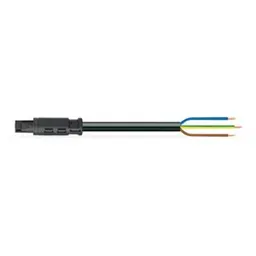
Cable assembly WINSTA ® RD with protection type IP20 For signal and power transmission: The WINSTA ® RD cable assembly with protection type IP20. Whether on PCBs, in control cabinets or for connecting lights – pluggable installation connectors from WAGO allow you to establish connections according to many different requirements in seconds. For greater security in electrical installations, the pluggable installation connector is equipped with mechanical protection against mismating. The pluggable installation connector is protected in accordance with protection type IP20 (When mated: IP2xC (These compact connectors are not designed for use in open, easily accessible areas!)). This means that users' fingers will never come into contact with energised elements. This pluggable installation connector can be used for a voltage load of up to 20 A. Thus, it can also be used for high power loads. With WINSTA ® RD, we have introduced a product line that fits like a glove into conduits or boreholes due to its design. According to the European CPR, the fire class of the cables used for construction is essential for building safety, too. For houses with average safety requirements, cable assemblies with fire class E are suitable. Eliminating halogens as an additive in the production of this cable assembly noticeably improves fire safety and reduces environmental contamination. Fast, error-free assembly thanks to cable assemblies from WAGO The cable is pre-assembled with a socket and a free end. The WINSTA® Pluggable Connection System allows pluggable electrical installation. This significantly reduces the need for servicing and lowers costs. Now you can also cut installation expenses without compromising quality and safety: with strain relief hosting eliminates the need for servicing and prevents unnecessary downtime. effective protection against mismating saves time, since no wiring is required at the construction site with A coding for use in a large number of general mains applications ready for immediate use convenient installation and commissioning