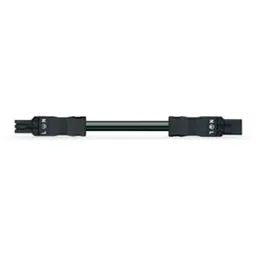
Cable assembly WINSTA ® MINI A coding The WINSTA ® MINI cable assembly with protection type IP20 is the pluggable solution for your application in control cabinets, on PCBs or for lighting connections. WAGO pluggable installation connectors are useful when criteria repeat or are planned on a defined pattern, for example for installing grid lighting or flush-mount lighting. For greater security in electrical installations, the pluggable installation connector is provided with mechanical protection against mismating. The WINSTA ® MINI pluggable installation connector with A coding in white or black is usually used for general mains applications in power distribution. If only limited space is available, our smallest pluggable connection system, WINSTA ® MINI, consistently displays its advantages. It is very compact, and, thanks to Push-in CAGE CLAMP® spring pressure connection technology, it additionally can be installed quickly, since the installation is low-maintenance and can be performed without screw connections. According to the European CPR, the fire class of the cables used in construction is critical for the safety of buildings as well. For houses with medium-level safety requirements, cable assemblies with fire class E are suitable. Eliminating halogens as an additive in the production of this cable assembly significantly increases fire safety and minimises environmental contamination. Fast, secure pluggable connections – cable assemblies from WAGO A socket and a plug are provided. The WINSTA® Pluggable Connection System allows pluggable electrical installation. This significantly reduces the need for servicing and lowers costs. Take advantage of the pluggable version of our maintenance-free spring pressure connection technology too! Plan your installation with with protection type IP20 from WAGO. protection against mismating eliminates errors compact design for conductors with a cross-section up to 1.5 mm² with A coding for use in many general mains applications custom-engineered solutions fast, secure installation