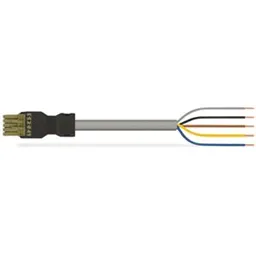
Cable assembly WINSTA ® MINI with strain relief The WINSTA ® MINI cable assembly rated current 16 A supports rapid, correct installation. WAGO pluggable installation connectors are used when criteria repeat or are planned on a specific grid, for example for installing grid lighting or flush-mount lighting. The mechanical coding and color coding of the pluggable installation connector ensure error-free installation of the individual components – including protection against mismating. The pluggable installation connector is protected against ingress by solid granular objects with a diameter of less than 1 mm in accordance with protection type IP40. B coding enables the WINSTA ® MINI pluggable installation connectors to be used for application control in automation, mechanical engineering and robotics. Due to its particularly compact dimensions, our WINSTA ® MINI Pluggable Connection System with Push-in CAGE CLAMP® spring pressure connection technology is especially suitable in very tight spaces, i.e., for installations when very little room is available. Of course, the safety of buildings must always be ensured, even after the electrical installation has been performed. The mandatory safety requirements in connection with EU CPR are met by this product through fire class E. Fast, error-free assembly thanks to cable assemblies from WAGO A socket and a free end are available. The WINSTA® Pluggable Connection System is perfectly tailored to the very strict requirements of building installation. It makes electrical installation pluggable, and consequently more efficient, even more reliable, and error-free. Use of this pre-assembled system reduces assembly times and errors during installation at the construction site. Choose quality and durability – with protection type IP40 from WAGO makes the installation of electrical components noticeably easier. effective protection against mismating easy tool-free operation, a wide range of coding options for automation controllers exact dimensions rapid, structured electrical installation